Tuesday, 16 August 2011

Walking the Whin Sill

We learned about The Whin Sill in school geography lessons, when we were coming to terms with the mind-boggling notion of fluid rock. Back then it bore the epithet 'Great' and for us Londoners it was a reinforcement of everything we were taught to believe about the north of England; a gritty, faraway wildnerness that spawned gritty, uncompromising peoples. These days I travel south to get to that not-so-faraway country. The wilderness has become familiar, although no less awe-inspiring. And the people? Well I guess they are the melting pot of humanity I have come to expect wherever I go, uncompromising only in their refusal to be stereotyped.

Irresistible force meets immovable object. The Tees finds a
weak point in the Sill at Cauldron Snout
Wherever it breaks the surface The Whin Sill makes for exciting scenery. My geography teacher was accurate in introducing us to it as one of the dominant and defining features of the landscape of northern England. From the Farne Islands in the east to the sudden Pennine escarpment in the west, it crops up in many of the region's most celebrated natural wonders. The river Tees hurtles over its ledges in a series of thunderous cataracts at High Force, Low Force and Cauldron Snout. It forms vertical, castellated cliffs at Holwick Scar and Falcon Clints and provides the setting for a geography master's dream, the near perfect glaciated valley of High Cup Nick. It delighted the Romans too; they built their famous wall along its ramparts at Hotbanks and Cuddy's Crags.

Made of a tough, dark igneous rock called dolerite, The Whin Sill was intruded into the horizontal strata of the surrounding bedrock some 295 million years ago, during a period of tectonic stretching. Wherever there was a gap the 1000 degree magma poured in like hot wax, bubbling up through a vent from unimaginable depths. Because it was not laid down on the surface in sediments but forced entry later, the Sill is not uniform, as generations of quarrymen and drillers have discovered. In some places it is hardly there at all, in others it may extend to a thickness of sixty or seventy metres.

Textbook dream. The Whin Sill forms a perfect band around
the glaciated High Cup Nick
It was quarrymen, in fact, who in the nineteenth century gave the Whin Sill its name. Whinstone is a local term for the rock which makes first rate road stone but which is generally thought too hard to fashion into blocks for house building. They called it a sill because it lies horizontally. It was therefore the original sill, before the term was coined for more general use by geologists. The typical columnar forms of the whinstone crags are a consequence of the magma cooling and fracturing along the vertical plane. Whinstone quarries are very much in evidence in this part of the country although many of them, like the mineral mines, are now thoroughly worked out. It is stll referred to as the 'Great' Whin Sill in some places, to distinguish it from the lesser 'Little Whin Sill' to be found outcropping in parts of Weardale.

The Whin Sill exposed: fracture columns of dolerite at
Holwick Scar, Teesdale
It's hard to be blind to the geology in this part of the land and, with an accustomed eye, it is possible to discern some remarkable shifts in the curves of the landscape, the pH of the soil and the flora over the length of a leisurely walk. One could hardly expect an event as cataclysmic as that creating the Whin Sill to leave the surrounding country rock unaffected. Above Cauldron Snout, superheating of the overlying limestone has altered its crystalline structure to produce an alkaline granular rock known rather wonderfully as 'sugar limestone'. I don't recall learning about that in Surrey school geography classes. Perhaps it didn't quite resonate with the craggy northern image my teachers were so keen to depict. Anyway, sugar limestone is home to some uncommon alpine plants like the beautiful blue Spring Gentian. Sadly there were none to be found on my last visit to the Cow Green Reservoir, which sounds like the perfect reason for going back.

Sunday, 14 August 2011

What's your poison?

'Who are you?' said the Caterpillar.
This was not an encouraging opening for a conversation. Alice replied, rather shyly, 'I - I hardly know, Sir, just at present - at least I know who I was when I got up this morning, but I think I must have been changed several times since then.'
'What do you mean by that?' said the Caterpillar, sternly. 'Explain yourself!'

If we were to choose one mushroom to stand for all mushrooms would it not surely be this? The Fly Agaric. The archetype 'toadstool' with its blood red cap flecked with white and its snowy gills has gone beyond being a mere living organism. It is a totem, a potent emblem branded into our consciousness from infancy through countless tales of folklore and fairies. From the brothers Grimm to Angela Carter, wherever there are wolves and woodcutters and wicked stepmothers it's a fair bet the Fly Agaric will be painted somewhere into the backcloth.

This mushroom - arguably more than any other living thing except perhaps the wolf - has come to symbolise our deeply held fears and suspicions about the malevolence of the forest. Red, as Snow White should have known before accepting the proffered apple, signifies danger. The bloody cap of the Fly Agaric, which seems to glow with its own light even in the forest penumbra, positively shrieks 'poison' at us. The skull-and-crossbones warning symbols in nearly all modern fungi guidebooks attest to its toxicity. But it hasn't always been that way.

There's no doubting that the Fly Agaric, Amanita muscaria, is cousin to some very dangerous mushrooms indeed. The large genus includes some notorious serial killers; the unambiguously named Death Cap, Amanita phalloides, and the beautiful ghostly white, and altogether more poetically named Destroying Angel, Amanita virosa. Between them these species account for the great majority of mushroom fatalities in Europe. The aforementioned guidebooks like to dwell on the gruesome symptoms, the delayed onset of which means their cocktail of toxins has already set about turning vital organs to soup before we know we need help.

By comparison, the Fly Agaric rarely kills us, although it may make us very ill especially if eaten raw. The principal active ingredient is muscimol, a simple little molecule but then so is ethanol (ethyl alcohol). Where the latter makes us behave like idiots, muscimol enables us to fly, to shape shift and, perhaps most intriguing of all, to see God. Not a drug for me, I should stress, but for those with more courage and less prejudicial cultural baggage than me, who are prepared to put up with the sweats and palpitations, it is an enticing way to meet our maker. Its use in shamanic rites in Siberia and Lapland has long been documented. It is hard to believe its psychoactive properties haven't been ritually exploited more widely.

When Alice encounters the hookah-smoking caterpillar who befuddles her with existential questioning, it is perched on a mushroom. John Tenniel's illustration isn't obviously a Fly Agaric but Lewis Carroll's text makes it plain he has an hallucinogenic fungus in mind. As a parting shot the disdainful caterpillar (the perfect shape shifter of course) advises Alice that eating one side of the mushroom will make her grow larger, the other side smaller. Dimensional mind-bending is apparently a commonly recorded experience of those who have indulged.

Fly Agarics are widespread in temperate mixed woodland across the northerm hemisphere. In the right conditions they can be locally common, as I encountered walking in Hamsterley Forest, County Durham, last week. There had been days of rain and mushrooms of all shapes and sizes had truly inherited the earth. The fruiting bodies of the Fly Agaric begin life above ground as tight buds enclosed in a white veil. When the veil ruptures fragments remain on the cap giving its typical warty appearance, but they may wash off in heavy rain. As the cap opens the gills separate from the stem leaving a white ring, or annulus, but again this is not always present.  Old specimens become flat and paler in colour, often full of holes where they have been eaten by insects, molluscs and even small rodents.


The toxic effects of this beautiful mushroom are potent and unpredictable and it is surely right that we teach our children to admire them without touching. It is a pity though that our caution fosters a more general, less focused, fear and ignorance about what is sprouting on the forest floor. Growing within a few feet of these Agarics I found some delicious ceps, Boletus edulis, left unharvested by the side of a well walked path. It is a peculiarly British prejudice I am learning to overcome with the help and knowledge of my continental friends who are avid mushroom hunters. Lewis Carroll's Alice, also a peculiarly British creation, seems to have had no such hang-ups, and lived to have many another adventure.

Friday, 29 July 2011

Them dry bones

'Time in the sea eats its tail, thrives, casts these
Indigestibles, the spars of purposes
That failed far from the surface.'

from Relic Ted Hughes

'Hydrogen peroxide?' 'Yes, that's right.' The shop assistant shook her head a little nervously. 'I'll ask the manager.' The manager eyed me up and down before confirming what I already suspected. 'We are not allowed to sell it any more.' Afterwards I thought how glad I was that she hadn't asked me why I wanted it. I would only have dug myself in deeper. 'Well, you see, I have these bones...'  I discovered later that it is quite easy to buy hydrogen peroxide on the internet (but then what isn't?). It seems rather perverse that something deemed too dangerous to stock in a chemist is safe enough to send through the post. In fact the chemist did stock plenty of hair products containing peroxide but I only wanted to whiten my bones, not condition them or give them a shiny bounce.

When I say my bones I don't actually mean my own, which I aim to keep safely tucked away on the inside for now. I mean the animal bones I have found on my travels and can't stop myself from picking up and bringing home. A few weeks ago I found a seal skull on the Fife coast near St Andrews. It lacks a jaw bone but is otherwise almost complete, even keeping some of its upper teeth. It is astonishing, ribbed and vaulted like a cathedral or a crypt, sculpted with precision for its purpose. I have washed all the sand out of it and it now sits in the bathroom, waiting to be treated. Hydrogen peroxide sterilises and whitens bone without reacting with and softening it as domestic bleach does.

For me, bones are among the most irresistible objets trouvĂ©s, rivalling shells in the intricacy of their design. They are things of beauty and curiosity and, cleaned up and brought into the setting of a modern home, they make striking ornaments and talking points. Reactions to my little collection of skulls and antlers vary, as you might expect. Some visitors find them ghoulish, others faintly unhygienic, overlooking the fact that they are far more sterile than houseplants or pets or ourselves! But plenty of folk seem to share my enthusiasm and are a little covetous. Some admit to having collections of their own. 


Gathering bones is as old as the hills. Of course many of their practical uses have been superseded and their decorative uses largely outmoded if not thoroughly outlawed. But bones retain powerful symbolic significances, much exploited and trivialised by popular culture. Their intricate architecture aside, what mostly entices me to pick them up is that strange capacity they have to remind me simultaneously of our transience and our permanance. In Ted Hughes' poem Relic, on the everlasting cycle of consuming and being consumed, the 'indigestibles' - the claws and carapaces and vertebrae that the sea disgorges - 'continue the beginning'.

It is an enviably succinct phrase. And that's what we all do, as we go through our lives, isn't it? We continue the beginning. Perhaps one day far from now, when I have quite done with my own inside bones, some stroller will find one by chance and admire it enough to take home. I find that very comforting.

Monday, 25 July 2011

The whole truth

'Facilius per partes in cognitionem totius adducimur'
Seneca the Younger (4BC to AD65) from Epistulae morales

I remember my early science classes at school. I don't think at that age we had split them into their separate disciplines. Sometimes, when the season was right, we would collect wild flowers from the school grounds and take them inside and dismantle them to learn about their constituent parts. Buttercups were a favourite; they were cheerful and simple and in plentiful supply. Looking back, I don't recall any qualms about us picking them, no cautionary lessons about sparing their less common brothers and sisters. There were words that hadn't been invented in those days, like 'ecosystem' and 'biodiversity'. Eden was there to be reaped, and raped.

Anyway, with nimble fingers and tweezers we pulled apart our chosen flower, laying out the fragments on a blank page. A tiny dab of glue was a precaution against sudden sneezes and boisterous classmates. Once we had our design just the way we wanted, a yellow and green five-pointed star, we would annotate it in pencil. Stipe and stigma, stamens and sepals, the alliterative words rang at once clinical and musical, equally at home in the poem and the operating theatre. When we were done the whole thing was covered in a square of transparent 'sticky-back plastic' (a phrase forever linked in my mind with Valerie Singleton, John Noakes et al). And there they were, our dissected flowers preserved for always, or at least until we grew tired of our no-longer-new exercise books and lost them.

It was a harmless enough lesson I suppose, but even at a young age I remember a certain disquiet about it. There was something a little unseemly about the end result, something not entirely edifying about dismantling a private thing of beauty and splaying it in this way. I must be careful here; with my adult sensibilities I can add connotations of sexual violation to what we were doing of which I am sure to have been innocent at the time. So what was it exactly, this undefined uneasiness? Disappointment, I think, and sadness. It is like the feeling I get in provincial museums and private collections looking at trays of displayed moths and butterflies. Musty and mouldering, they signify age suspended, a chimera of everlasting beauty. Drop the tray and these little pinned-out Dorian Grays will disintegrate into dust.

Our exercise, intended to reveal, had merely exposed. The flat page showed us what but not why. We learned nothing of how our specimens aligned themselves to the rays of the sun, or how they opened to the insect vectors of their choice, why they grew abundantly here but not there, why they flowered in June but not April, why they were golden yellow and not blue or white. Our neat two-dimensional creations had anatomy but lacked vitality; stems and stamens yes, but no soul.

The quotation above, written by Seneca in a letter at the end of his long life, translates as 'We are more easily led part by part to an understanding of the whole.' This linear and very Latin approach to learning has been enshrined in our education system ever since. We break things down, take them one step at a time, allow time for assimilation before moving on. But it is a method not without fault. A compartmentalised approach to learning can easily accentuate the differences between things rather than the commonalities. It spills over into other aspects of our society, leading to linear cause-and-effect responses to probelm solving. Our piecemeal approaches to clinical medicine and law-making are examples, they are rarely holistic. It seems we can never entirely put Humpty together again.

My disappointment with my buttercup was, I suppose, a first lesson in Gestalt; the whole is not merely the sum of its parts, an aphorism attributed with some dispute to Aristotle's Metaphysica. It has become fashionable to disparage the grand old philosopher in our iconoclastic age but his explorations of the origin and essence of things, of primal existence, have illumined our view of ourselves in a way that is unparalleled in Western thought.

Later I went on to study natural sciences at college, at times conducting laboratory exercises far more brutal and pointless than dismembering buttercups. And often I was left with that same elusive unease that we were missing something. We found out what things were made of but not what made them the way they are.

I have some of my school exercise books still, those jottings of another me. None contains a flower preserved under plastic I'm pleased to say. These days I prefer to wade knee-high through buttercup fields, relishing how radiant they are in their wholeness.

Friday, 22 July 2011

The Balmerino chestnut

Like the first monks I came to Balmerino in Fife on foot. Unlike them I had walked only a few miles along the coast, carrying nothing but a packed lunch and a camera. They came across open country all the way from Melrose, bringing the religious trappings they needed to found a new Cistercian monastery. No doubt they had beasts and covered carts and plenty of help from the lay community. And they had their unswerving faith in those early days. Nevertheless, in 1227 it would have been quite a trek. But then, unlike me, they came at the behest of a queen.


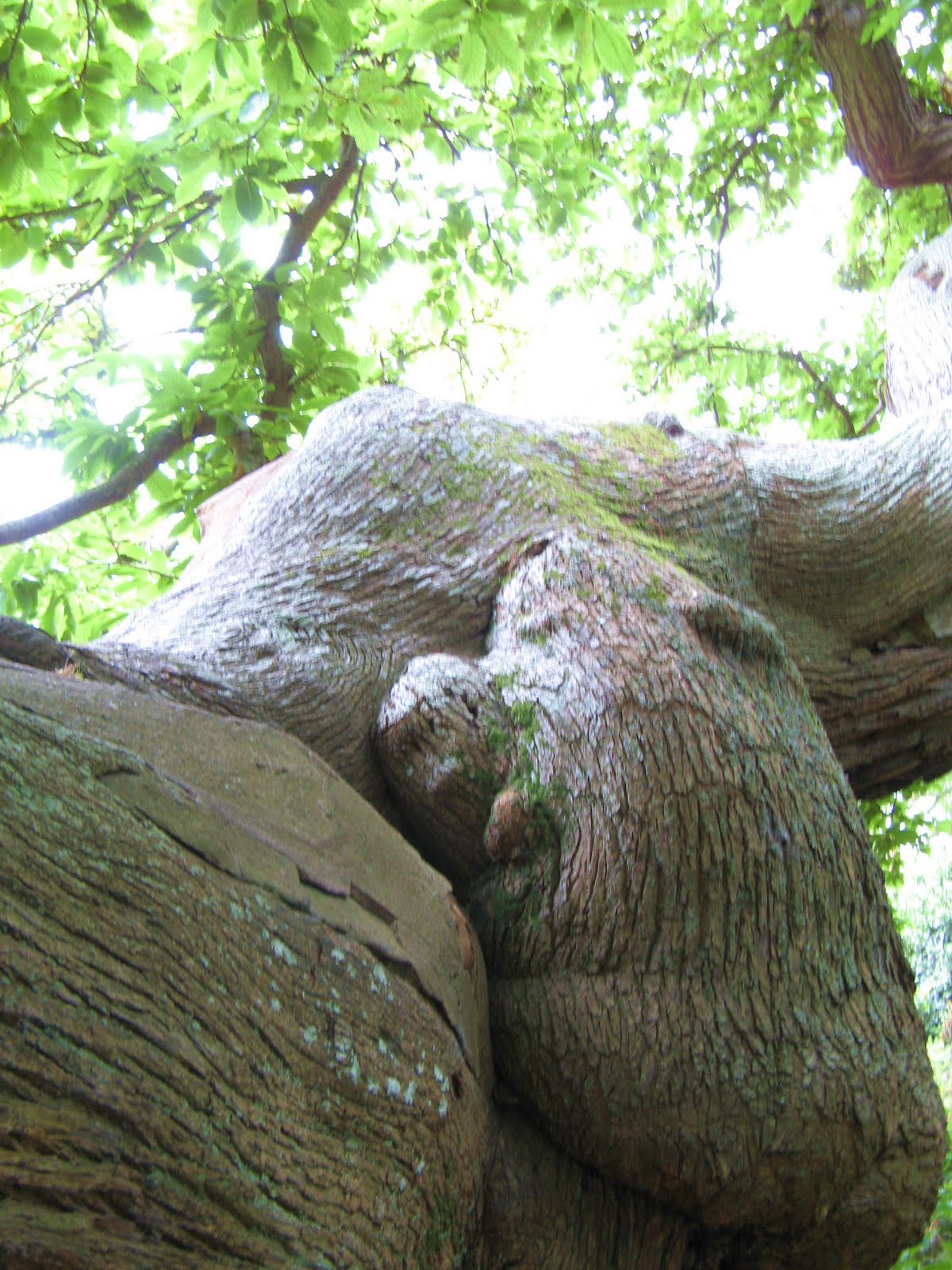
The story goes that Ermengarde de Beaumont, widowed queen of William the Lion and the Abbey's founding patron, planted a Spanish chestnut tree on the site to mark the occasion. It is tempting to believe the story that the tree growing in the grounds today is Ermengarde's gift to her new monastic community. If true, that would make it some eight hundred years old. Sweet chestnuts are certainly confirmed as living to that age in other places. Some Corsican specimens are said to have lived for a milennium. Sadly the tired old giant at Balmerino is likely to be only half that age. Ironically, that would have seen it planted around the time of the Abbey's demise during the Dissolution.


Supported by props, the scars of past amputations patched over with mortar, the Balmerino chestnut could almost be a metaphor for the ruined Abbey itself. The little that remains of this always small, never wealthy, daughter house of Melrose is presently off limits, deemed unsafe by its keepers, Historic Scotland, for clambering visitors. The hope one day is that sufficient funds will be raised to stabilise the masonry that survives and allow full access. Meanwhile, the Balmerino chestnut lives on, instilling a sense of secular awe in latter day pilgrims like me.

Wednesday, 13 July 2011

A Sky worth subscribing to

The much heralded 'digital switchover' has taken place in our part of the world. Our trusty old terrestrial analogue television signals are no more. I suppose it will be a little piece of history by the time the switchover programme completes in 2012; another milestone in the digital communications revolution. Despite all the advance publicity and my desk-sharing with a colleague working on a project to support those less able to manage the change, I still managed to forget about it when the time came. I had a grumpy five minutes on returning from holiday to discover nothing was where I had left it on my television.

Now I am thoroughly re-tuned and unsurprised to discover that in spite of having the best part of a hundred channels to select from, I still have difficulty finding much I can be fussed to watch. Lucky, then, that there is no shortage of alternatives to the (not so) little black rectangle in the corner of the room. Top of my list just now has to be weather watching; probably not what News Corp and the other stakeholders in BSkyB had in mind when trying to entice me to subscribe to Sky, but a whole lot more entertaining.

Spot the glider!
Although it may be deserving of many epithets, nobody could accuse this summer's Scottish weather of being dull. After the fierce, tree-culling gales of May, in Edinburgh this last week we experienced violent thunderstorms and flash floods accompanied by strange mammatus clouds. These clouds, so named because they have the appearance of breast-like mounds projecting below the main cloud base, are quite rare in Britain. They will be more familiar to my readers in the US where their appearance is often an early warning sign of tornadoes. They signify unusually turbulent currents within the thunderheads above, and steep temperature gradients

Storm moving across Fife
On a calmer note, our prolonged daylight hours after sundown have this week been showing an even rarer feature, one of the best displays of noctilucent clouds for many years. Noctilucent clouds are made of tiny ice crystals at great altitude, far exceeding that of any other clouds. On summer nights, when the Earth's surface is in shadow but the sun sinks not far below the horizon, high layers of the atmosphere (the mesosphere) are still illuminated in the northern sky giving the clouds, where present, a ghostly, diaphanous glow.

Some of these effects have been quite localised. They require being in the right place at the right time and with a camera to hand. I haven't managed either of these particularly well and sadly have no pictures of these phenomena of my own. However, there is a wonderful shot of the noctilucent clouds over Portobello beach on the website Talk Porty. I was out of town when the Edinburgh storms came although a week earlier I did witness something similar in Dundee; no mammatus clouds but midnight skies in the middle of the afternoon and the city bombarded with hailstones the size of hazelnuts. This picture of RRS Discovery was taken on my mobile phone shortly after the storm passed, about 4pm on a midsummer day!

Unstable airflows have been moving across northern Britain for months now. They may not make for ideal summer weather but the visual effects have been dramatic. As our great painters of clouds, John Constable and JMW Turner, knew well, there isn't a single colour on the palette that can't be found in the sky in the right conditions. It makes for great viewing day and night. It is a Sky worth subscribing to, except of course we don't need to.

Friday, 8 July 2011

Poppies in July

'You flicker. I cannot touch you.
I put my hand among the flames. Nothing burns.
And it exhausts me to watch you

Flickering like that, wrinkly and clear red, like the skin of a mouth.'

Sylvia Plath wrote two mature poems on the theme of poppies, both dating from 1962 and bearing in their title the month of their composition. Both appeared in the posthumously published Ariel although it is not certain that would have been her intention, had she lived to assemble the final manuscript herself. But they surely belong together, disconcerting twins born a few months apart but progeny of the same stock.

Like most of her late poems Poppies in July (quoted above) and Poppies in October are written in free verse. The language is sparse and urgent, pruned of the superfluous words that filled and sometimes flawed her earlier style. They share an imagery too, of skirts, mouths, blood and noxious vapours; the flowers represent splashes of vibrant, pumping life addressed by a protagonist who is pale and listless and passive by comparison.

Poppies are startling flowers, often gaudily sumptuous in a landscape of muted shades. Seeing them scattered red and black among fields of summer wheat and barley it is easy to understand why they were favourites of the impressionist and pointillist painters. The flowers in Claude Monet's Poppies, Near Argenteuil (1873) almost seem to flicker in the way Plath describes them.

Their association with euphoria and painlessness ('your liquors seep to me, in this glass capsule, Dulling and stilling.') and the sinister payback of dependency, decline and death were not lost on Plath either. 'There are fumes that I cannot reach. Where are your opiates, your nauseous capsules?' she asks in July, while the allusion to carbon monoxide in October is, of course, agonisingly prescient.

Sylvia Plath had a genius for taking everyday things, especially things to which we more usually ascribe benign romantic associations  - candles, mirrors, the moon, flowers and so on - and injecting them with new significances, subverting them into things charged and edgy and dangerous. I can gasp at poppies, but I can never quite look at them without recalling these poems, Sylvia Plath's 'little hell flames.'

Tuesday, 5 July 2011

An incantation of moons

THE Scottish night sky promises rather lean pickings for planet watchers in the month ahead. Of our Earth's five solar system companions visible to the naked eye only one, Jupiter, offers much to look at during July and even then only for early birds (or very late owls). Venus will soon move behind the sun. Mercury - always a challenge at the best of times - might be glimpsed in the post sunset afterglow. Mars and Saturn are low in the pre-dawn sky but faint enough to need binoculars, Mars getting slowly brighter as Saturn fades.

Part of the reason for the poor show ought to be obvious, there isn't much night sky at the moment! Another is the angle of the ecliptic. The solar system is a remarkably flat disc. Most planets orbit the sun in the same plane with not much more than a few degrees of variation. On summer nights the sun dips only shallowly below the northern horizon. Correspondingly, the planets are low too. Light from objects at low elevations reaches us through more atmosphere. The atmosphere with all its movement and pollutants disturbs the light rays, resulting in fainter, fuzzier images.

But Jupiter is fun to watch, often by far the brightest thing in the sky (our moon excepted of course). Even viewed through binoculars its disc grows larger, where stars remain the same size. I use a birdwatching telescope and on good nights I can clearly see Jupiter's famous coloured bands and the four Galilean moons, so called after their first observer Galileo Galilei four hundred and one years ago. The moons have an ecliptic of their own and can often be seen strung out in a line to one side of the planet.

The Galilean moons! As a child I used to chant their mysterious names over and over, as if through my incantation I might summon the mythological lovers of Jupiter (or Zeus) in the flesh. Io, Europa, Ganymede and Callisto... Io, Europa, Ganymede and Callisto. Conquests of Jupiter might be a better collective description as all, three girls and a boy, were pursued, deceived and taken by force. Io, Europa, Ganymede and Callisto...  In fact it wasn't Galileo who named them but a rival, Simon Marius, a German astronomer. His claim to their discovery has been largely forgotten but his apt names have persisted.

An incantation of Jovian moons
Attempts to get my camera and telescope to speak to each other have so far yielded disappointing results so this picture isn't mine, but it gives a good idea of what you should expect to see. Galileo was a generous, or perhaps just prudent, man. He dedicated his discovery to his patron and former maths pupil Cosimo de Medici, Grand Duke of Tuscany.  He was also genius, devising a means of telling the time and longitude from nightly observing the relative positions of  'Cosimo's stars'. And he was fortunate to live in a part of the world and an age where clearer skies were guaranteed!

As July goes on Jupiter will rise earlier, so by the end of the month it will be up by midnight. I'll be away in my tent again by then, free of Edinburgh's light pollution. Telescope at the ready I will start up my incantation. Io, Europa, Ganymede and Callisto... Io, Europa, Ganymede and Callisto. Join me?

Sunday, 3 July 2011

Return of the giant hogweed

'Turn and run! Nothing can stop them. Around every river and canal their power is growing.' Funny, but it has never occurred to me before now that Peter Gabriel's apocalyptic, if rather fanciful, lyrics to The Return of the Giant Hogweed (Nursery Cryme 1971) are about the true story of the introduction of the plant to the Botanic Gardens at Kew during the great age of Victorian acquisitiveness, and its inevitable consequences. In Gabriel's re-telling the giant hogweeds take on the guise of John Wyndham's triffids, bent on vengeful human annihilation.

Giant hogweed by the river Esk
Last week I was writing about our harmless native hogweed. Today, walking the river Esk in East Lothian, I came across an immense infestation of giant hogweed, Heracleum mantegazzianum, an altogether more frightening encounter. There were many specimens of easily twice my height and the large area, completely overrun by the plant, was sealed off behind barbed wire. And for good reason... giant hogweed is best given a wide berth.

The plant produces a sap which reacts with ultraviolet light. Even mild contact such as brushing against the hairy stems can leave the skin hyper-sensitive to sunlight, resulting in painful and persistent blistering that may recur for years. The giant stems are hollow, making them attractive for children's games as swords, blowpipes or telescopes, with potentially horrible consequences. There are cases of hospitalisation every year.

As Peter Gabriel laments, giant hogweed, which originates from the Russian Caucasus, is virtually indestructible, requiring a co-ordinated effort by landowners, local authorities and environment agencies over a many years. According to East Lothian Council's website, council officers are engaged in a long-term campaign of eradication, backed by legislation making it an offence to plant giant hogweed or to allow it to grow unchecked on private land.

Sandra has written recently about the tenacity of weeds and the futility of our attempts to submit them to our will. Readers of my earlier posts will know that I, too, am an admirer of the weed. I am left with a sense of deep ambivalence about plants like the giant hogweed and Himalayan balsam and others. After all, we reap what we sow. Brought to Britain as ornamental curiosities, they are one legacy of the colonial hubris of our ancestors. In spite of all our best (and costly) efforts at eradication they are almost certainly here to stay. Containment through responsible environmental management is probably the best we can hope for.

Let me stress I have absolutely no wish to see children blinded or disfigured through contact with this plant, any more than I would want to see people bitten by adders, poisoned by mushrooms or injured by any other agent of our natural world. In that sense we are fortunate in Britain that there is not much out there to do us serious harm. But in our enlightened twenty-first century do we still entertain the eradication of species on the grounds that they are potentially harmful to us, our pets or our livestock? What is missing from East Lothian Council's website is surely what should be the second prong of its campaign, education. There are no photographs or drawings by which to identify the plant, no advice for parents or gardeners on avoiding contact or what to do if experiencing symptoms. We must kill it, that is all.

The giant hogweed is undoubtedly impressive although not especially attractive. It is certainly a plant to be treated with extreme caution. On balance it would probably have been better if Victorian gentlemen collectors had not brought it here. But they did and we must learn to live with it as we must the grey squirrel, the sycamore, the mink, the rhododendron, the New Zealand flatworm and the myriad other newcomers to our islands. We should remember that unlike John Wyndham's sci-fi triffid, the giant hogweed isn't an invader, we introduced it.

Thursday, 30 June 2011

Knowing your umbels

It has been a soggy June north of the border, following on from one of the wettest Mays on record. Parts of west Scotland recorded rainfall levels of 250% the monthly average. Watching news coverage of parched earth and stunted cereal crops in East Anglia it is sometimes hard to credit we live in the same small isle. On the plus side, nothing grows without rain and it has been a season of rampant growth. Hedgerows, meadows and lanes are ablaze with wild flowers and it is hardly possible to go for a country walk without wading through a strangle of brambles and nettles and tall stems of hogweed with its profusion of white and pinkish flowers.

The unkindly named hogweed is a member of the carrot family, a very large group of mostly white or yellow flowering plants which includes many important culinary species like chervil, cicely, caraway and angelica and others with medicinal properties. Many of them grow to a great size, none more so than hogweed which often reaches shoulder height. The giant hogweed, not native to Britain although widespread here, may tower to ten feet or more.

Typical flat topped umbel of common hogweed
Like most of the carrot family, common hogweed or Heracleum sphondylium bears its small flowers in spoked clusters called umbels (think umbrella). These may be the breadth of a hand span and are typically flat topped and borne high about the stout hollow stems. For novices like myself telling umbelliferous plants apart can be confusing as they may be very variable and the individual flowers are often indistinct. Usually the shapes of the leaves give better clues and fortunately they often grow together, making for easier comparison.

And identification is important, for mixed in among these aromatic herbs and also bearing white umbels are some of the most poisonous plants to be found anywhere, the hemlocks and water dropworts, which are potentially lethal to humans and livestock alike even in comparatively small doses. Some of them are all the more dangerous for being common and all parts of the plants are toxic; leaves, seeds and especially roots. Hemlock poisoning, which causes respiratory paralysis while still conscious, was apparently a favoured means of execution in classical Greece. Its most celebrated victim was Socrates, put to death for his outspoken criticism of Athenian democracy, whose demise is told of by Plato in the Phaedo.

Outermost flowers of each cluster are larger
Common hogweed isn't poisonous, nor is it something you would probably want to try to eat, but it does have a taxonomic name with classical associations, Heracleum. I wonder whether this is simply a reference to its size or whether like Achillea, the yarrow - which Greg wrote so interestingly about- there is some other significance that I am missing.

It is fairly straightforward to identify from the flowers alone. They are often pink when still buds, the ones in the centre of each umbel being the last to open. There are five petals and flowers at the outer edges of the cluster have a pair of larger petals, projecting outwards, shaped rather like miniature fish tails. The flowers are much frequented by insects including bees. They give off a mildly unpleasant scent which I have only really noticed on hot, muggy days when the flowers are very abundant. Hogweed's attraction of insects potentially makes it a valuable companion plant for crops because it may aid pollination or pest control. Certainly it is often found around field edges but I think it unlikely that its seeds have been sown purposely as it is naturally invasive.

I don't suppose hogweed will feature high on the list of favourite wild flowers for many people and I must count myself among them. But I associate it with countless country walks on summer days when the sky is blue and the air is hot and fizzing with insects. And in our current, decidedly unspectacular Scottish summer, that surely can't be bad.

Thursday, 23 June 2011

The unruly sun

'BUSY old fool, unruly Sun,
Why dost thou thus,
Through windows, and through curtains, call on us?
Must to thy motions lovers' seasons run?'


From The Sun Rising  John Donne

Today is Midsummer's Eve and for days the local newspapers have carried advertisements from country hotels inviting us to bonfire parties in their gardens. In true Scottish tradition the thunderclouds have been brooding all day but no doubt the venues are well prepared with marquees from which spectators can enjoy their rib roast and solstice-themed cocktails while staying dry.'Experience all the excitement of a real Celtic fire festival!' one advertisement enticed. I suppose in these challenging times they can't be blamed for trying but it was tempting to let them know that Midsummer bonfires have little to do with the Celts. While undoubtedly pagan, the parts of Britain with the strongest traditions of bonfires in June are Norse or Anglian, not Celtic.

So Midsummer is upon us, that curious time after the solstice when the sun, at the extreme limit of its station, appears to hover unmoving and undecided in the sky, rising and setting at almost the same time each day. It is, after all, what the word solstice means, from the Latin solstitium, or 'sun-halting'. Like its counterpart at the other end of the year, 24 June has been conveniently commandeered by the Christian calendar as the Feast of John the Baptist who, the Gospel of St Luke tells us, was born six months before Christ and 'jumped in the womb' on learning of the Virgin's conception.

At school we learned that the summer solstice occurs each 21 June and like much else we learned at school, while generally true it is not universally so. In fact the solstice may fall on 20 June (as it last did in 2008) and may be as late as 22 June (although this last occurred in 1971 and won't happen again in any of our lifetimes). This year, in Britain, it fell a little after 6.16pm on the date my school approved of, although those of us living in the northern half of the country could be forgiven for not noticing as it poured with rain and barely seemed to get light all day.

The mathematics behind the precise calculation of the solstice is complex, so perhaps my school should be excused for wanting to keep things simple. But I can't help thinking the lack of punctuality exhibited by something as big as the sun would have been a cause for some consternation among my teachers. It was hardly setting the right example!

With the mixed blessing of hindsight, it seems now that much of my schooling was a sequence of learning and unlearning in this way. We were taught absolute truths only to have them dismantled a term or two later once we were deemed ready for subtler lessons. Thus we learned that electrons orbit around the nucleus of an atom in distinct 'shells', so many electrons to each. Our calculations of valency and compound formation relied on this certainty. Well, no actually, it's not like that at all.

It wasn't so bad a preparation really. The rest of my life, too, has involved as much unlearning as learning. But the trouble with unlearning is that it is often painful, reluctant and incomplete. We don't like to let go of what we thought we knew. We don't want to hear that Shakespeare didn't write every word of his own plays or that Columbus didn't discover America, or that water doesn't go down the plughole the opposite way in the southern hemisphere any more than we don't want to hear that our friends will sometimes let us down or our government doesn't have our best interests at heart.

Anyway, I digress. To get back to the solstice, the problem (if indeed that's how we choose to see it) of the unreliable timing isn't anything to do with the sun. The Earth wobbles on its axis like a spinning top, its orbit is disturbed by the gravity of other planets and, above all, our calendar is just not clever enough. An average orbital year is 365.242199 days. Our Gregorian calendar gets as close as it can. Its sophisticated cycle of leap (intercalary) days in years divisible by four, but not if they are divisible by 100 unless they are also divisible by 400 (still with me?) is a big improvement on its Julian predecessor. But it still means we'll be about a day awry every 3,300 years. Further refinements have been proposed but never adopted, perhaps because a further consideration then comes into play, the spinning of our Earth is slowing down so days are set to get longer!

But that's quite enough arithmetic. Celtic or Norse, Julian or Gregorian, our forebears knew better than to reduce the solar calendar to mere numbers and fractions and we should follow their instincts. Sunsets and sunrises remain high on may people's lists of their most memorable experiences, eclipses and other solar special effects even more so for those lucky enough to see them. We may no longer be attuned to the stations of the sun quite as we once were but there's no questioning the power of our own private star to stir wonder and awe in us.  I'm sure gatherers at damp hotel bonfires will have a good time this evening whether the skies are clear or not, but I wish them at least a glimpse of the star of the show.

Monday, 20 June 2011

Euphemia de Clavering

Her name is musical, her tomb mystical and like most women of her time, high born or otherwise, we know precious little about her. She died some time around 1320. We don't know what she died of but by medieval reckoning she was an old woman, in her fifties. There are records of her having at least fourteen children but with one exception we don't know how many of them survived infancy or what became of them. We know the names of her parents, her husband and one son, but that's about all. There are no surviving descriptions of her, not even stylised eulogies, and her tomb bears no inscription. What did she look like, I wonder? What was her character?

In 1343 her son, Ralph Neville, Second Baron of Raby, enlarged the south aisle of the church of St Mary (formerly St Gregory) in the village of Staindrop (a mile or so from his family seat at Raby Castle) to house his mother's tomb. Her effigy lies inset into the south wall, mounted by an ornate canopy. There are other effigies nearby, including one of a child. They were not re-discovered until the nineteenth century during restoration work in the church. They will also be members of the powerful Neville dynasty, but their names are lost to us.

I like to think Ralph Neville loved his mother dearly. Effigies such as Euphemia de Clavering's are not uncommon in English medieval parish churches but hers is especially finely done. The detail is very personal and moving, from her peaceful countenance, eyes closed, lips slightly apart, to the long lines of buttons on the sleeves of her tunic and the patterning on the band of her headdress. Most touching of all are the reclining angels to each side, their hands stroking her head in gentle consolation.

For nearly seven hundred years she has slept in silent prayer in her alcove. She has weathered the vicissitudes of cold and damp and careless worshippers. She has survived the internecine feuds of her family, the upheavals of Reformation and Civil War and the fluctuating tastes of centuries of church restorers. She has come through all that intact and, with our modern sensitivities to conservation, it is hard to believe she will not now lie there for another seven hundred years and beyond.

There are other, grander tombs in St Mary's, Staindrop, although none so old as Euphemia de Clavering and none as deeply devotional and personal. For all her historical anonymity she has achieved immortality of a sort. It is what I believe Philip Larkin meant by the closing lines of his poem about another tomb: 'to prove Our almost-instinct almost true: What will survive of us is love.'

Sunday, 19 June 2011

Let's hear it for the garden warbler

We should be honest, in the appearance stakes the garden warbler has an image problem, a reputation for being our dowdiest of birds. In a land where the non-enthusiast complains there are plenty of LBJs ('little brown jobs') for company, the garden warbler (he or she, for the sexes are alike) has made an art of plain dressing. He has no crest to strike a pose, no rufous breast to square up to a rival; he has no flashing wing bars or cocky eye stripe with which to woo a mate. His absence of distinguishing features, the RSPB notes with an exclamation mark, is itself a guide to identification. So who will speak up for the garden warbler? What can be said for this drab little bird?

To begin with, it is rather misleadingly named, unless you have the kind of garden that requires the services of a modern-day Capability Brown. Its taxonomic genus Sylvia gives a better clue to habitat. The garden warbler has a liking for woodland, especially for mature broad-leaved, deciduous trees from which it may venture into parks but never strays far. Sylvia borin is the specific name - not 'Sylvia boring' as I have heard before now.

Garden Warbler from Wiki Commons
What else? Like all our British warblers it diets mostly on insects, from which we can deduce several things. It is a summer visitor when food is plentiful, a long distance migrant. The garden warbler comes to us from central and southern Africa and its annual stay is a short one. Usually it has left again by early August. Catching enough insects to fatten up for the return flight is hard work, so warblers are active birds, rarely staying put for more than a few seconds. All in all its nondescript plumage and tendency to flit about in dense leaf cover makes the garden warbler a challenge to spot.

But if we can't see it we can always listen, and here is the reward for our effort. I suppose it ought to be a lesson to us that this plain little bird has one of the loveliest of songs. It comes in short bursts of a few seconds, like an out of practice soprano with plenty of power but short on breath. The notes are are all sweet without any of the scratches and whistles often associated with other warblers. But it is also elusive, never quite resolving into a 'tune', never quite repeating a refrain. Apparently the song contains much mimicry of other birds but it is delivered at a speed that makes this hard to discern. It would be revealing to hear a recording slowed down.

Many connoisseurs of birdsong have been lyrical in their praise of Sylvia borin. Sir Edward Grey, Liberal MP and British Foreign Secretary from 1905-1916, took much solace from birdsong in the dark days leading to the First World War. In his The Charm of Birds (1927) he places the garden warbler in the first order of songsters, running a close second to its stable mate, the blackcap. 'To my ear the opening notes of the blackcap's song and those of the garden-warbler are so alike that I hear them with a doubt of which bird I am listening to; but the garden-warbler goes on and on for a longer time and yet never seems to liberate its voice upon the air so completely as the blackcap does. In other words, a garden-warbler's song seems always on the point of an achievement to which only the blackcap attains.'

Another keen ornithologist, French serialist composer Olivier Messiaen was in awe of birdsong all his life. In the 1970s he published La fauvette des jardins, a thirty minute piece for solo piano, as his tribute to the supremacy of the garden warbler. The composition makes no attempt to imitate the song, but instead draws original inspiration from its tinkling beauty.

I have just spent a week camping in the quiet countryside of Teesdale, county Durham. The song of the garden warbler was part of my daily alarm call, some mornings rather earlier than I might have wished for! He (or she) had a favoured bush close by, a stopping off point on his territorial rounds, from which a few bursts of notes were rendered before moving on, ever restless, ever hungry. But even further afield his song was loud enough to lift above the general chorus. Like Sir Edward Grey, I was charmed. Like Olivier Messiaen, I was inspired. In a country of 'little brown jobs' there is nothing boring about Sylvia and we do well not to judge a bird by its cover.

Friday, 10 June 2011

The first thousand

'Each friend represents a world in us, a world possibly not born until they arrive, and it is only by this meeting that a new world is born.'     Anais Nin

Since opening dysnomia... in April with no real purpose in mind beyond posting some of my favourite pictures, I have just topped my one thousandth pageview today. That might not seem like much to the seasoned bloggers among you but it is rather more than I anticipated. So, welcome to dysnomia... to those who have dropped by from Germany and Russia, USA and Canada, Spain, Portugal and France, Denmark and Ireland.. and of course to my viewers closer to home. Thank you for leaving comments, especially for your kind words in times of recent sadness. A special thanks to Cricket for helping me create dysnomia... and to Madzia, Ben, Greg, Nevine and Karime for signing up as followers and to others I know are following. Please keep the comments coming, send me interesting things and spread the word.

I shall be away in a tent minus computer and internet for the next week but will be seeing new things, gathering images and ideas for future posts. Looking forward to the next thousand. Dysnomia... has no borders and never closes.

Tuesday, 7 June 2011

She sells seashells

I post this picture as a modest tribute to Mary Anning, fossil hunter extraordinaire and one of my first childhood heroines. Two hundred years ago in 1811, at the age of just twelve, she and her brother Joseph uncovered the first ever fossil skeleton of an ichthyosaur, from the cliffs of Black Ven, Lyme Regis (and still on display in the Natural History Museum, South Kensington).

Over the next twenty years Mary went on to further dramatic discoveries in the treacherous Jurassic mudslides at Black Ven, helping to transform our understanding of geological time and evolution in an age when Biblical creationism still held sway. Despite her expertise, as a woman of little education from an impoverished background she had no hope of being accepted into the scientific elite, although they were happy enough to visit her at Lyme and let her guide them on local expeditions. Most of her life she quite literally scratched a living, selling her own fossil finds from a local shop and was immortalised in the famous, if slightly disparaging, tongue-twister She sells seashells on the sea shore. The shells she sells are seashells, I'm sure.

As a child I always imagined myself making a spectacular find of my own whenever we went anywhere with rocks and cliffs. My parents lived briefly in Lyme Regis and we spent a happy day in Mary's footsteps. Somewhere I still have the fragment of ammonite I found that day.

Sunday, 5 June 2011

Hawks among the headstones

Quite a crowd had gathered by the time I arrived and at first it was difficult to see the attraction. But as the bodies parted, I saw him, just a few feet away on the other side of the railings in the grounds of Edinburgh's Cathedral of St Mary. 'Oh!' I exclaimed. 'A sparrowhawk, how exciting!' And there he was, a male bird with striking grey and pink barred plumage, glaring defiantly back at us. Beneath his talons, stunned but still living, was a stricken feral pigeon. In a characteristic pose he made a canopy with his wings, concealing his prize. The more squeamish members of the crowd made shooing noises. One woman pleaded 'can't you make it stop?' Another asked 'why doesn't it fly away?' Male sparrowhawks are not large birds, sometimes only half the weight of their mate. The pigeon was simply too heavy to lift, too tasty to leave. It was a showdown.

This dramatic photograph is not mine. It was taken by Jane Barton of the Hampshire Ornithological Society. I hope she will not object to me reproducing it here as it captures closely the scene I witnessed.

In the general gloom of declining bird populations the urban sparrowhawk has been something of a success story. The Edinburgh Hawkwatch project, which monitors local sightings of the birds, estimates that 30 or more pairs may breed within the confines of the city, a remarkable recovery from the former indiscriminate persecution suffered by all our birds of prey. Sparrowhawks nest high in trees and Edinburgh is well endowed with inner city woodland. Prime sites are some of the older, less manicured cemeteries. Other bird species do well too in the dense cover of the graveyards and that's good news for sparrowhawks which diet almost exclusively on small birds.

My favourite corners of Edinburgh's cemeteries will remain my secret and they give the appearance of being largely forgotten. They are certainly not the parts frequented by tourists in search of famous graves. In fact I doubt they receive many visitors at all. I encounter occasional dog walkers but that's about it. I find this rather surprising given the general appeal of all things gothic. Headstones bearing all manner of symbols and memento mori emerge like crooked peg teeth from a sea of undergrowth and the crumbling, ivied mausoleums are picturesque in the true aesthetic meaning of the word. They are best in dappled sunlight or when a breeze shakes big drops of rain from the broad-leaved canopy after a downpour.

At each end of the day in particular the cemeteries are busy with birds. Blackbirds and dunnocks rummage in the leaf litter, song thrushes entertain from high perches and wrens trill or tick angrily from crevices in the masonry. In winter flocks of redwings comb the grass, seeming to move as one as they search for worms in the iron ground, and fieldfares strip the shrubs of berries. I have heard laughing woodpeckers and, on lucky days, the shrieking calls of sparrowhawks.

I know of at least one cemetery nest site near the centre of the city and it can be a noisy place in May and June. The nest itself is well hidden but the birds betray their presence with their calling. Roles at the nest are clearly defined and account for the pair's difference in size. Exclusively the female incubates and watches over the vulnerable newborn chicks while the male hunts. His returns to the nest are greeted by volleys of banshee catcalls that sound eerie among the surrounding gravestones. It may be just my imagination but other birds seem to grow quiet and watchful when the male is present, although I have never witnessed him hunting so close to the nest.

In common with all raptors, the predatory habits of the sparrowhawk and its effects are widely and sometimes wilfully misunderstood. There is aboslutely no evidence that the return of the birds to our urban spaces has contributed to declining songbird numbers. Mortality rates among small birds are very high anyway. The hawk, a highly territorial bird, is an integral part of the population equilibrium, and simply wouldn't stay to breed if there was not an adequate food supply. Nevertheless, sparrowhawk nest sites remain vulnerable to persecution, which is why I am not telling where mine is.

Saturday, 28 May 2011

The edge of our island

A few years back there was a short-lived flurry of media interest in a normally unremarkable farmhouse near the village of Coton in Derbyshire. Based upon calculations by the trusty Ordnance Survey, Church Flatts Farm was officially declared the place in Great Britain farthest from the sea, a mere 70 miles away. To be precise, the location is in a field a short walk to the south of the farm.

Needless to say the announcement provoked some controversy. The location was disputed. The 'centre' of Britain, it was argued, is not necessarily the same thing as the remotest point from the coast. After all, Britain is not circular. The distance was disputed too. The river Trent is tidal and on a high tide brackish water may encroach upstream to within 45 miles of Church Flatts. Never mind the statistics, it was all a bit of fun. The BBC turned up and some chap built a sand castle topped with a Union flag to mark the spot. Well done Brits!

There are two points to my writing about this. The first is that 70 miles really isn't all that far. None of us lives truly landlocked in Britain. The second is that, camera crew aside, hardly a soul ever visits the place. Save for a toy flag on a heap of sand it is unmarked, unnoticed, unromantic. It occupies no place in our imagination. Compare that with the cardinal points of our coastline. We teem in hundreds to Land's End and John O'Groats and are charged for the privilege of standing at the ends of our little piece of earth. Sadly these days the names have more romance than the locations themselves but we are not deterred. Some of us venture farther still: the Scilly Isles, Ardnamurchan, Muckle Flugga, St Kilda; the names ring with an exotic maritime poetry.

Perhaps it is a small island mentality but the siren song of the coast seems irresistible. We are drawn to the fringes of our land as we are to the seaward railings on the deck of a ship. We look outwards to the horizon. There are immediately obvious attractions in a coastline. It is exciting and varied, we have a great deal of it for such a small nation (just how much is the subject of a celebrated mathematical paradox, of which more another time) and there is always plenty going on. Large tracts of the British coast are accessible and it is full of recreational possibilities. We run and hike, fly kites and skim stones; we build castles, walk dogs, watch birds and poke around in its pools; we paint the coast, write about it, collect little pieces of it to fetch home. And like everything else we have tried to impose our human will over it. We have created safe moorings for our boats and built defences against flood and erosion. Where the land isn't quite enough we have defied the sea by extending it, building jetties and piers and filling them with all our human trappings.

We go to the coast when we are happy, in love, when we have things to talk through or are in need of inspiration, when we are pensive, reflective, desolate even. Whatever our mood or our motives, the coast and the sea seem to offer us something beyond the merely diverting or aesthetic. The lure of the sea has been much written and sung about.  It tugs at something elemental and primeval within us. For all the riches and beauty of the interior of our country it is not enough, the horizons beckon. The lore of our islands abounds with tales of drowned villages, ghost mariners, half-human sea people. We cock our heads to the waves and we hear voices in the tricks of the wind and the mewing gulls. Perhaps they are the voices of our ancestors, summoning us home.

I am fortunate to see the coast almost every day. I travel along a stretch of it on my journey to work and I sit at a desk not 70 yards from the sea, never mind 70 miles. Some days the sea is angry and grey, on others glassy calm. The opposite shore may glint back in the sun or be softened by mist. Some days it vanishes altogether. It is never the same view twice. I hope the owners of Church Flatts Farm are happy where they live. Derbyshire is a beautiful part of the country. I wonder whether they have the same sense of living on a small island with a long edge. I wonder whether the sea calls them in the way it does me and whether they answer.

Tuesday, 24 May 2011

A thought for the trees

An unusually deep depression has swept across the northern British Isles today, unusual for this time of year at least. The time-lapse satellite images are beautiful to watch, an elegant spiral unwinding on a west to east trajectory, like the captivating pictures of distant galaxies or those mysterious traces left by sub-atomic particles spinning off from collisions in a nuclear accelerator.  The whorls of clouds look peaceful and just like the shots of galaxies and smashed atoms they give no sense of the mayhem being wreaked within. No wonder the spiral has been such a potent symbol throughout human history.

Winds have gusted at close to 100 miles per hour in exposed parts of Scotland, bringing a predictably dismal story of commuter chaos and disrupted power supplies. My own evening journey was several hours longer than usual and only made possible at all by the generosity of friends providing a relay of lifts. We arrived home tired and hungry but it was a temporary inconvenience which by tomorrow will be told of as an adventure.

It is the trees I feel saddest about. The streets and gardens are littered with shredded leaves and dismembered limbs. There are fractures and raw wounds everywhere. Many tired old specimens have been uprooted completely. Storms in winter, though often fiercer, tend to cause less damage. The trees are bare and the sap has retreated. A brittle branch may be sacrificed, snapped off to save the whole, but the body survives and repairs. By May even the late trees are in full leaf, weighed down with primavera foliage. Winds like today's may be too much for them to withstand.

Tomorrow, as train timetables get back to normal and television channels are restored, we should pay our respects to the lost trees. We can all bend only so far.

Sunday, 22 May 2011

In memoriam

I visited a very magical garden today. Terraced into the hillside of a burn in the Scottish Southern Uplands, it is the vision of a Nepalese family and specialises in Himalayan flowering plants. It was raining and unseasonably cool for late May. Wind chimes tolled and prayer flags flapped to and fro in the stiff wind. Every now and again a thinning of the cloud let through more light. The papery petals of blue poppies were suddenly backlit with translucent radiance. It was beautiful; a place where I imagined nothing bad could ever happen.

And then something bad did happen, something quite dreadful. I received a text message. The partner of a dear friend had died suddenly during the night before of a heart attack. He was still a young man, whom I knew well and liked very much. He and my friend had been married a little over four years. Their wedding had been a very special day of celebration. It would be hard to picture two people happier together.

I sat for some moments among the raindrops and the blue flowers utterly abandoned by words. Hours later I am still struck dumb by this inexplicable, random act of violence that has torn into the life of my friend and his family. I can barely begin to imagine their grief. In the absence of words I offer pictures; blue poppies in a magical garden, bowed by the blows of summer rain, then lit up as the cloud breaks. I offer them to the memory of Jim and with my strongest love and hope for Ian.

'Though lovers be lost love shall not; And death shall have no dominion.'